

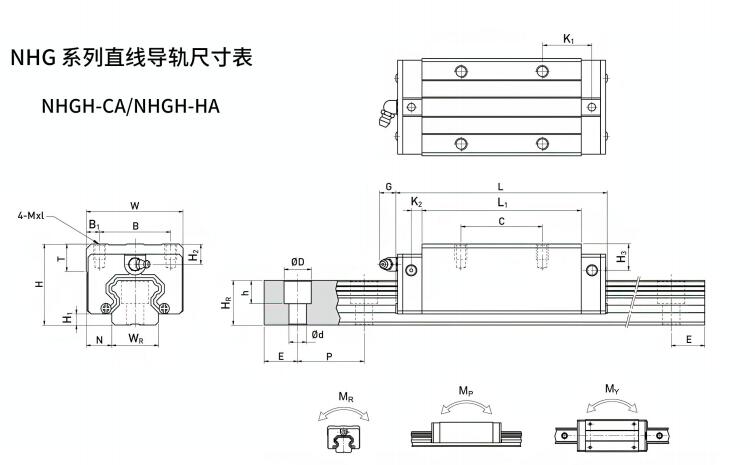
| Inquiry | Designations | Unit Dimensions (mm) | Block Dimensions (mm) | Rail Dimensions (mm) | Rail Mounting Bolt Dimensions (mm) | C(kN) | C0(kN) | MR(kN-m) | MP(kN-m) | MY(kN-m) | Weight | |||||||||||||||||||||
|---|---|---|---|---|---|---|---|---|---|---|---|---|---|---|---|---|---|---|---|---|---|---|---|---|---|---|---|---|---|---|---|---|
| H | H1 | N | W | B | B1 | C | L1 | L | K1 | K2 | G | Mxl | T | H2 | H3 | WR | HR | D | h | d | P | E | Block (kg) | Rail (kg/m) | ||||||||
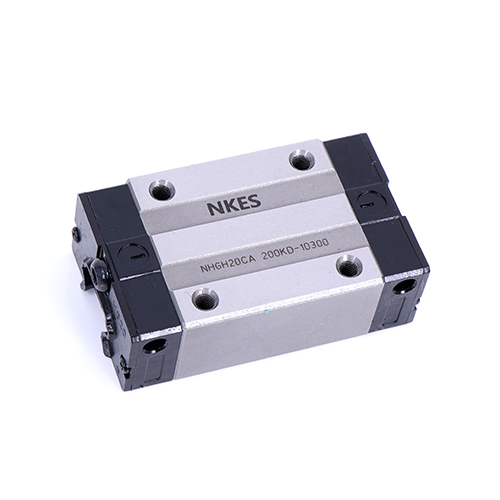
A linear guide is a precision motion system that provides smooth, low-friction linear movement along a single axis. It consists of a stationary rail and a moving carriage that supports and guides loads.
Unlike plain bearings, linear guides use rolling elements like balls or rollers between the rail and carriage to minimize friction. The rolling elements recirculate within the carriage, enabling infinite travel along the rail. The raceway grooves on the rail contact the balls or rollers, allowing the guide to handle high loads and torque in multiple directions.
Key advantages include high rigidity, accuracy, and load capacity. These guides are essential in machine tools, semiconductor equipment, and 3D printers, where precise, repeatable motion is critical.
 Russian
  Portugal